The Confidence Trap: When The First 30 Days Of A Product Experience Aren’t As Under Control As You Think
161 SaaS leaders told us their trial onboarding is in good shape. Their own numbers disagree with them on four separate fronts. Here's a quick audit to see where your team lands.

92% of SaaS leaders say they’re satisfied with their visibility into the first 30 days of the product experience. Ask a follow-up question, though, and the picture changes fast: only 24% of those same teams track where users actually drop off during onboarding. Only 24% track NPS or CSAT from new users at all.
That’s not a footnote. It’s the headline finding from a survey we ran of 161 SaaS product, growth, marketing, technology, and UX/research leaders, all answering questions about how their company manages the first 30 days of the product experience. This is the crucial window where someone either finds enough value to become a paying customer, or quietly disappears.
It isn’t a one-off contradiction. The same shape shows up four separate times in the data: strong, sometimes near-unanimous confidence, sitting on top of a structure that’s never actually been stress-tested.
We’re calling it the confidence trap. If you run product, growth, or marketing at a SaaS company, there’s a decent chance your team is in it on at least one front. Below is a short audit to help you find out which one.
The confidence trap, defined
A confidence trap isn’t dishonesty. Nobody in this survey was lying about what they believe; they were reporting their genuine read on their own onboarding experience. The trap is what happens when a team’s sense of control over an experience outpaces the instrumentation, testing, or ownership actually backing it up.
The first 30 days of a trial is exactly the kind of window where that gap grows without anyone noticing. It’s short. It’s high-stakes. And, as we’ll get to, it often sits in the organizational space between departments that each quietly assumes someone else has it covered.
Why the timing makes this worse
Before the four tests, it’s worth a gut check on when conversion actually happens.
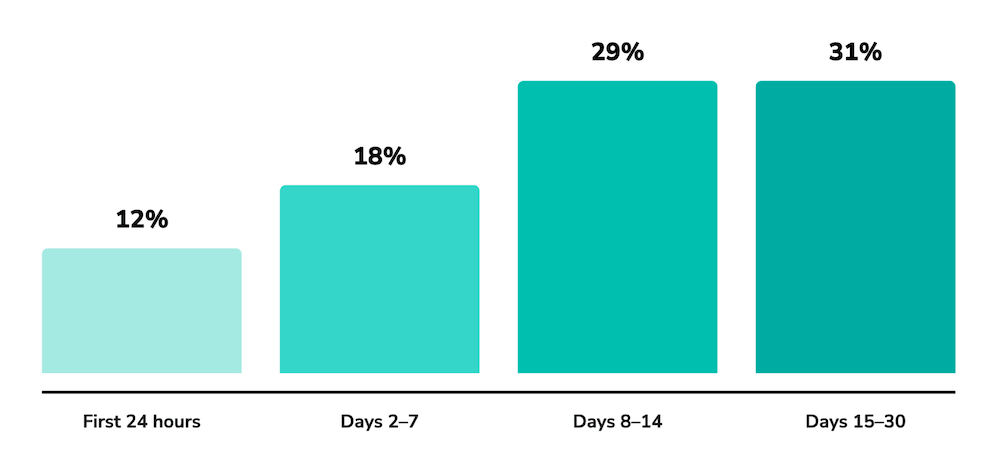
Asked when users most commonly convert from trial to paid, leaders reported: within the first 24 hours, 12%; days 2 through 7, 18%; days 8 through 14, 29%; days 15 through 30, 31%. Add it up, and 60% of conversions land between day 8 and day 30, well after the “obvious” first-week activation push most onboarding sequences are built around.
The length of the trial shapes that timeline, too. Companies with a free trial or freemium tier see 33% of users convert within the first week, compared with 23% at paid-only companies. A visible countdown creates urgency that a slower, sales-led motion doesn’t have built in. But if most conversions still land in weeks two and three, the emails and prompts a user gets on day two shouldn’t be aiming to close the sale. They should still be building the case.
That mismatch is exactly what shows up when you ask leaders, in their own words, what their biggest blind spot is:
“My biggest blind spot is assuming new users understand the underlying logic of how our product works right from the start.”
— Technology leader, data & analytics company, 1K–10K monthly active users
“The biggest blind spot is understanding where users become confused, lose confidence, or stop seeing value during onboarding. It can be difficult to capture the emotional side of the experience through analytics alone.”
— Product leader, B2B data & analytics company, 100,000+ monthly active users
“We track the metrics and drop-off points well, but our biggest blind spot is the qualitative why behind abandonment.”
— UX/research leader, B2B design & creative company, 200–1,000 monthly active users
Teams can see that users leave. Far fewer can say why, or when it really mattered.
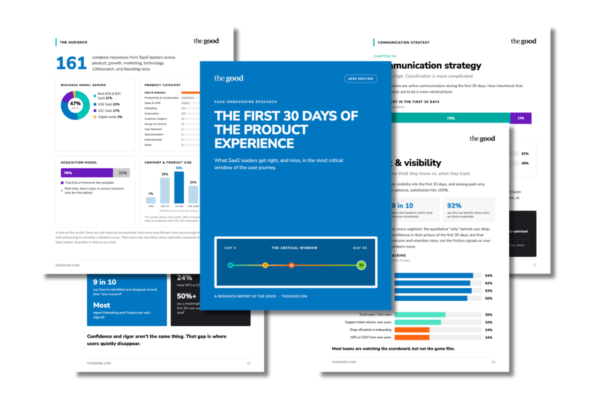
Want the rest of the data? What’s included is a fraction of what 161 SaaS leaders told us. The full First 30 Days of the Product Experience report breaks down every finding in this article in more depth, including splits by business model, company size, and product category we didn’t have room to cover here. Download The Full First 30 Research Report
Test 1: Are you tracking outcomes or friction?
Here’s the first place confidence outpaces structure. 92% of leaders say they’re satisfied with their visibility into the first 30 days, 9 in 10 say they have clear baseline metrics they track consistently, and 92% say they can identify where users are likely to abandon.
Now look at what’s actually on the dashboard. Outcome metrics are well covered: time-to-first-key-action (54% of companies track it), trial-to-paid conversion (52%), day 1/7/30 retention (53%), feature adoption and usage depth (50%). Friction signals are a different story. Only 35% track email open or click rates, 32% track support-ticket volume from new users, and just 24% track drop-off points in onboarding or NPS/CSAT from new users.
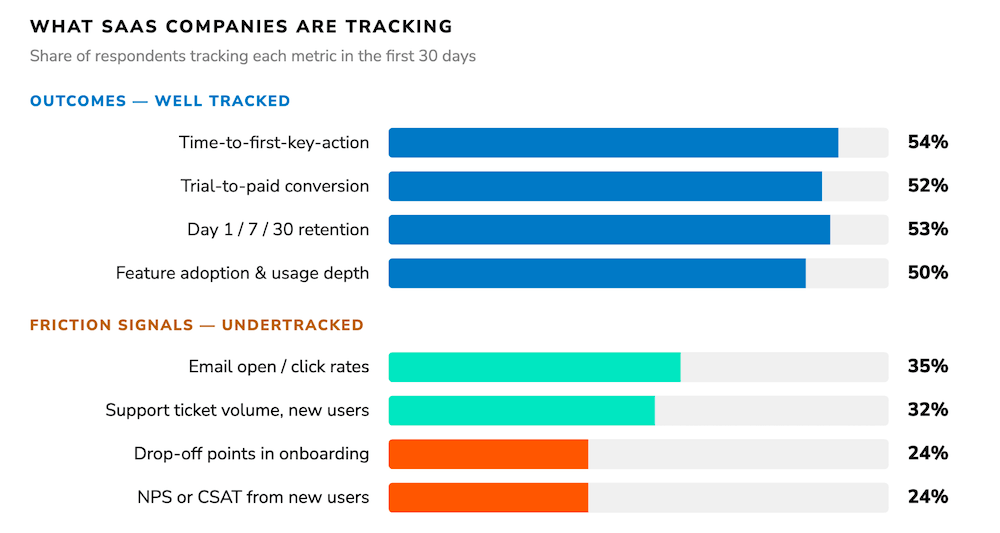
Outcome metrics tell you a user left. They don’t tell you where, or why. If your team can rattle off last month’s trial-to-paid rate faster than it can name where onboarding drop-off happens, you’re watching the scoreboard instead of the game film.
Where do you land? If drop-off tracking and new-user sentiment aren’t metrics your team reviews as often as conversion rate, you’re in the trap on this front.
Test 2: Do you know your aha moment, or have you proven it?
About 90% of leaders say they know exactly what their product’s “aha moment” is, the point where a new user genuinely gets why the product matters. 9 in 10 say they’ve researched why users churn in the first 30 days, and 9 in 10 use competitive analysis to benchmark their own onboarding.
That’s a lot of confidence in a moment that, by design, is hard to verify from the inside. And the cracks show: 1 in 6 teams admit the research they produce doesn’t reliably influence the product or onboarding it’s supposed to inform.
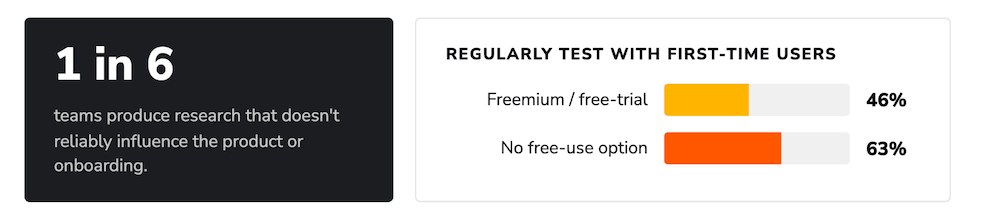
Testing directly with real first-time users, not internal stakeholders, not lookalike audiences, happens regularly at only 46% of freemium or free-trial companies, and 63% of paid-only companies, whose more guided, sales-assisted onboarding leaves less room to skip that step.
Knowing your aha moment and proving that new users actually reach it are two different exercises. The first is a workshop. The second requires watching real people hit friction you didn’t anticipate.
Where do you land? If your “aha moment” hasn’t been validated with a first-time user in the last two quarters, you may think you know what it is, but you haven’t proven it.
Test 3: Is everyone aligned, or does someone actually own it?
This produced the highest agreement scores in the entire survey: 95% say Marketing and Product are well-aligned on the first 30 days, 90% have a clear, documented strategy, and 89% share a unified definition of what a successful first 30 days looks like.
Then ask a more operational question. How much of the first 30 days falls into “no man’s land” or the space where no team has clear day-to-day ownership?

Only 9% of leaders report complete, seamless coverage. 18% say most of it is unowned, and another 39% say a significant portion is. Asked who should own it, there’s no consensus leader: growth teams get the largest share at 34%, followed by product (21%), customer success or onboarding (21%), and marketing (19%).
Agreeing on a goal and owning the touchpoints that get you there are not the same thing, and that gap deserves a closer look on its own. For now, the short version: if your team says “we’re aligned” but can’t name who owns the day-4 email or the day-12 in-app prompt, you’re aligned in the strategy doc and unowned in practice.
Where do you land? If you can’t immediately name an owner for onboarding email, in-product prompts, and support handoffs for every day of the trial, some of your first 30 days is no man’s land, too.
Test 4: Is your communication intentional, or just heavy?
89% of leaders say every email sent in the first 30 days is intentional and coordinated across teams. Only 46% describe their overall communication strategy as regularly optimized, and 28% (rising to 38% among data & analytics companies) call it “mostly set-it-and-forget-it.”
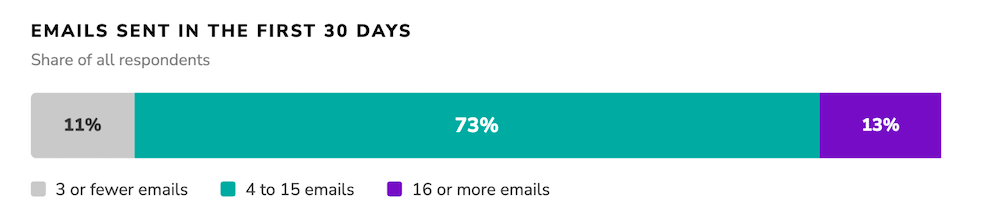
Volume isn’t the problem. 73% of companies send 4 to 15 emails across the first 30 days, and 13% send 16 or more. That’s a reasonable cadence on paper. The problem is that volume and intentionality aren’t the same thing. A sequence built once at launch and left alone can still feel “coordinated” to the team that built it, while looking, from the user’s side, exactly like what it is: a calendar firing on autopilot.
Where do you land? If your onboarding sequence hasn’t been reviewed against actual conversion timing in the last quarter, you may suffer from a confidence gap.
Closing the gap
The pattern across all four themes is the same: high self-reported confidence, sitting on top of a structure nobody has recently stress-tested.
That’s not a knock on any single team, and it’s rarely a knock on the specific teams typically owning the process. A product marketer, a lifecycle or growth marketer, someone in customer marketing: this is exactly the connective work they’re hired to do, and in most companies, somebody is doing it.
But the problem is that the role rarely comes with authority over every piece the experience actually depends on.
A product marketer can write the onboarding sequence, define the activation goal, and see precisely where users stall, but the empty states and paywall timing live in the product roadmap, support fields the tickets, and sales owns the day-12 follow-up call. The job is assigned. It’s the cross-functional pull to act on all of it that’s rarely resourced.
That’s a big part of why ownership fragments the way it does. Each team holds a piece without the authority to run the whole arc.
Closing that gap doesn’t require a bigger team or budget. It requires being more deliberate about touchpoints that already exist:
Measure the friction, not just the outcome
Conversion rate and retention are lagging indicators. They tell you a user left, not where or why. Add drop-off tracking, NPS at key moments, and support-ticket analysis, and treat them as first-class metrics instead of nice-to-haves.
Get more precise about the aha moment
“Users see the value” isn’t specific enough to design around. Define the exact, observable behavior; for example, the dashboard that populates or the workflow completed without help, and then test whether real first-time users actually reach it.
Map the first 30 days touchpoint by touchpoint
If a significant portion of the experience has no named owner, the fix isn’t a better alignment doc. It’s a full map, every email, prompt, and handoff from signup through day 30, each with an owner, a goal, and a next step.
Treat your email sequence like a product
Review it at least quarterly. Check send timing against when conversions actually happen. If most users convert on days 8 through 14, the emails they get on days 1 through 3 should be building the relationship, not asking for the sale.
Close the loop between research and action
Findings that live in a shared doc nobody revisits don’t improve anything. Build a lightweight process for turning research into actionable, owned items on a defined timeline.
This is a short list any team can start running against its own first 30 days this week. Where it tends to get harder is the outside part: someone who isn’t close to the roadmap, doesn’t own any of the four functions above, and can look at the whole 30-day arc at once.
That’s the gap where The Good spends our time. If you want a structured, research-first look at where your own confidence and your own data are quietly disagreeing, that’s a conversation worth having. Get in touch.
About the Author
Katie Encabo
Katie Encabo is the Customer Success Manager at The Good. She focuses on supporting and improving the experience of top-performing ecommerce and SaaS growth teams as they optimize the digital experience for their users.