
Free Trial vs. Freemium vs. Reverse Trial: SaaS Trial Strategies & The Tradeoffs That Can Shape Your First 30 Days
Three SaaS trial strategies. Three psychological dynamics. Three different ways users can fall out before they ever convert. Know the difference before you build.

Free trial. Freemium. Reverse trial. Each is a growth strategy, but they’re not interchangeable.
These three SaaS trial strategies create fundamentally different user experiences in the first 30 days. They prompt different psychological dynamics, different activation patterns, and different failure modes. Choose the wrong one for your product, and you risk building an acquisition engine that quietly undermines your retention.
This article is about understanding those tradeoffs so you can choose the SaaS trial strategy that will work hardest for your product and goals.
Why the first 30 days are different from everything that follows
For a long time, SaaS growth conversations were almost entirely about acquisition and how to get people in the door. Then the industry shifted toward product-led growth, and the conversation moved to how to let the product do the selling.
Both are valuable. Both have moved the industry forward. But they miss a key point about the user experience.
Acquisition optimizes for volume, but doesn’t consider what happens after. Product-led growth optimizes for the in-product experience, but can lose sight of a holistic customer experience when looking at specific tactics or product elements.
The full first 30 days of the user experience are the growth lever that acquisition and PLG both depend on, but neither explicitly accounts for. It spans onboarding, activation, habit formation, and the conversion moment itself, and it involves every team from product to marketing to customer success.
The trial model is one of the many consequential decisions within that window. It determines what users experience on day one, what motivates them to come back on day seven, and what they stand to lose if they haven’t converted by day thirty.
The three models
Free trial: time creates urgency
The time-limited free trial has been the SaaS standard for a long time, typically 7, 14, or 30 days of full or near-full access. The intuitive logic is that if you let people experience the product’s full value, they’ll want to keep using it.
The psychological engine here is loss aversion. Once users have access to something, the prospect of losing it is more motivating than the prospect of gaining it was in the first place. In Behind The Click, I mention that “the pain of a loss is more intense than the joy of an equivalent gain.” The free trial activates this by design. Access is real, but temporary.
The problem is that urgency without activation is just pressure.
If a user signs up for a 14-day trial and doesn’t experience a genuine “this is for me” moment in the first few days, the countdown clock doesn’t help them. It just reminds them that something is about to expire that never quite clicked. The trial ends. They don’t convert. And in many cases, they’re not even sure why.
Free trials perform best when your product has a short time-to-value, when users can reach a meaningful outcome in hours or days. After all, 90% of users churn if they don’t understand a product’s value within the first week of signing up. B2B tools that replace a painful workflow are natural fits. The urgency is well-placed when users have already seen the point.
Where they fall apart is when time-to-value is long. Complex onboarding, required integrations, multi-stakeholder adoption. The trial clock often runs out before users are even ready to evaluate the product honestly. The champion has to go back to procurement. The window closes before the decision gets made.
For the first 30 days, this means activation has to happen fast, ideally in the first three to five days, or the trial becomes a countdown to churn rather than a runway to conversion.
Freemium: patience as a growth strategy
Freemium flips the model. Instead of a time limit, there’s a feature limit. Users get access to a real, functional version of the product forever and pay to unlock more. There’s no clock.
The psychological foundation is different here. Rather than loss aversion, freemium leans on the endowment effect: users who build something inside a product, customize their setup, or integrate a tool into their workflow begin to feel a sense of ownership over it. Switching becomes costly not because of price, but because of sunk investment. The most durable freemium conversions happen when users have genuinely built something they’d lose by leaving and see the opportunity to improve it with premium features.
Freemium is also a long-game for distribution. Free users tell other people about tools they use. They create network effects. For products with a social or collaborative component, freemium can be the engine that makes growth feel organic rather than purchased.
The feature-gating decisions are where most freemium strategies succeed or fail. The goal is to understand which actions your most engaged users take most frequently, and which of those correlate with eventual conversion. Free tiers should let users build the habit, then prompt an upgrade when they want to go further. The line is thin, and it requires real data to draw correctly.
Strong freemium products have a free tier that’s genuinely valuable, not crippled, but naturally bounded. The paid tier unlocks something users will want as they grow: more seats, more storage, more output, more advanced capability. The upgrade moment is self-evident because the user has already hit the edge of what they need.
When it doesn’t work, it’s usually one of two things. The free tier is so generous that most users never need to upgrade. Or it’s so limited that users never experience enough value to care. Both are design failures rooted in the same cause: not understanding what jobs users are actually hiring the product to do.
For the first 30 days, the dynamic shifts away from conversion pressure and toward habit formation. The goal is to get users to a workflow integration deep enough that the product becomes part of how they work. Progressive onboarding, contextual education, and early identification of expansion signals all matter more here than they do in a free trial model.
Reverse trial: a boldest bet
The reverse trial is newer in practice but older in logic. Coined by Elena Verna, users start with full paid-tier access. At the end of the trial window, if they don’t convert, they drop to the freemium tier.
The difference from a standard free trial isn’t just structural. It’s psychological. Users who start at the top experience the product’s full capability first. They build workflows, generate outputs, and form expectations based on what the product can do at its best. When the trial ends and features are removed, the loss is concrete. They know exactly what they’re giving up, because they’ve been using it.
Compare that to a standard freemium user who has never seen the premium features. To them, upgrading is a gain. To a reverse trial user, not upgrading is a loss. That’s a meaningfully different motivational state.
There’s also a priming effect at work. The reverse trial sets the frame from day one: this is a premium product, and you’re being extended a temporary privilege. Users don’t spend the trial period evaluating whether the premium tier is worth paying for. They’ve already been living in it.
This model works particularly well when freemium has high distribution value (you want the free tier to exist), but you’ve historically struggled with free-to-paid conversion because users couldn’t envision what the upgrade unlocked. It lets them experience the answer instead of imagining it.
The failure mode is specific: when users don’t actually adopt the premium features during the trial window. If onboarding fails to expose the valuable capabilities, the reverse trial collapses into a free trial with worse UX. The user loses access to features they never used, and the downgrade feels arbitrary rather than motivating. This model demands more intentional activation design than either of the other two.
In the first 30 days, the goal isn’t just “get to value.” It’s “get to paid-tier value specifically.” In-app prompts, usage nudges, and proactive communication about which features are trial-only all become load-bearing parts of the experience.
Before you choose: read the competitive landscape with verb scoring
Most teams approach trial model selection by looking inward. What does our product do, how fast can users get value, what do we want to protect behind a paywall? That’s necessary, but it’s only half the picture. Your users don’t evaluate your trial in a vacuum. They evaluate it against every other tool they’ve tried in your category.
That’s where verb scoring becomes useful as a pre-decision tool, not just a freemium gate-setting exercise.
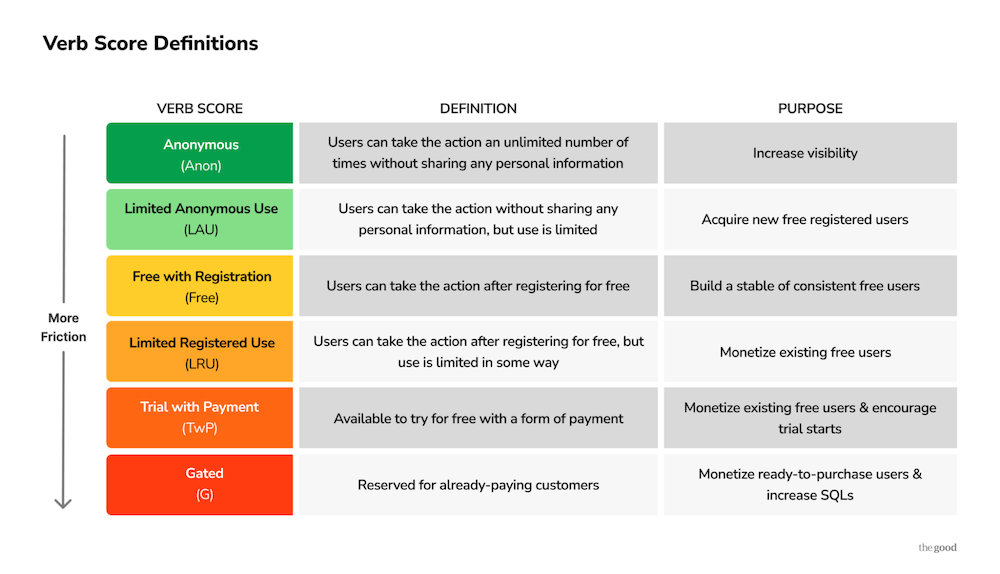
Verb scoring is a methodology for analyzing competitor products by cataloging the specific actions (verbs) users can take at each tier, then mapping where competitors draw the line between free and paid. When applied to your competitive set, it surfaces something that internal strategy discussions rarely produce: a clear picture of what your market has been trained to expect for free.
This matters for trial model selection in a few concrete ways.
If every major competitor in your category offers a freemium tier and yours doesn’t, your free trial is entering a market where users have been conditioned to expect indefinite free access. A 14-day clock will feel more aggressive than it would in a category where time-limited trials are the norm. Verb scoring won’t tell you to match competitors reflexively, but it will tell you what you’re asking users to accept that they haven’t had to accept elsewhere.
The analysis also reveals where competitors are strategically vulnerable. If a competitor’s free tier gives away a capability that their paying customers say is their primary reason for staying, that’s a gate that isn’t doing any real work. If another competitor is aggressively protecting a specific action behind their highest tier and users consistently mention it in reviews as a frustration, that’s a signal about perceived value worth incorporating into your own structure.
For reverse trial design specifically, verb scoring is almost a prerequisite. The reverse trial works because the premium experience is meaningfully better. But “meaningfully better” is partly a relative judgment: better than what users are getting elsewhere, not just better than your own free tier. Understanding what premium looks like across your category helps you calibrate which features to put front and center during the trial window and which ones users will most viscerally miss when the downgrade happens.
Done well, a verb-scoring analysis of three to five competitors gives you a map of market expectations before you commit to a model. It’s a few hours of structured research that can save you from building a trial experience that feels tone-deaf to people who’ve already been shaped by your category.
Haven’t heard of Verb Scoring before? We’ve got you.
- Read More: An Introduction to Verb Scoring: What It Is and How To Leverage It For Product Acquisition & Monetization
- Read More: 9 Use Cases For Verb Scoring To Support A Successful Product Strategy
Matching model to product
Choosing between these models isn’t about which one posts the best aggregate conversion data. SaaS products are too different from each other for that to be useful guidance. It’s about matching the model to your product’s specific dynamics.
Three questions worth sitting with:
How long does it take a user to get real value?
Short time-to-value, measured in hours or days, favors the free trial. Long time-to-value, where the product requires integrations, configuration, or team adoption before it clicks, means the countdown clock often runs out before users are ready to evaluate. Freemium or reverse trial will serve you better.
How big is the gap between your free and paid experience?
If the free tier is genuinely useful and users will naturally grow into its limits, freemium is the right frame. If the premium tier is dramatically better but hard to appreciate without experiencing it, reverse trial is worth testing. If there’s no free tier at all, a time-limited trial is the best bet.
Who is doing the evaluating?
Individual users have different dynamics than procurement committees. The reverse trial tends to work well for individual adopters who make fast decisions. Freemium is a strong bottoms-up strategy when individual users can sign up and build internal momentum over time. Free trials fit well in sales-assisted motions where there’s a human available to guide the evaluation.
Using the ROPES Framework to understand what your users actually need
Once you’ve matched a trial model to your product’s dynamics, the next question is harder: do you actually know what your users need to experience during that window? Not what you think they need. What they demonstrably need based on how they move through the product.
This is where our ROPES Framework becomes a practical tool for trial design. ROPES maps the end-to-end customer journey for product-led growth products, stage by stage: Registration, Onboarding, Product Experience, Evangelize, and Save. Each stage has distinct goals, key metrics, and levers you can pull, and each one has a direct bearing on whether your trial model produces the outcomes you’re designing for.
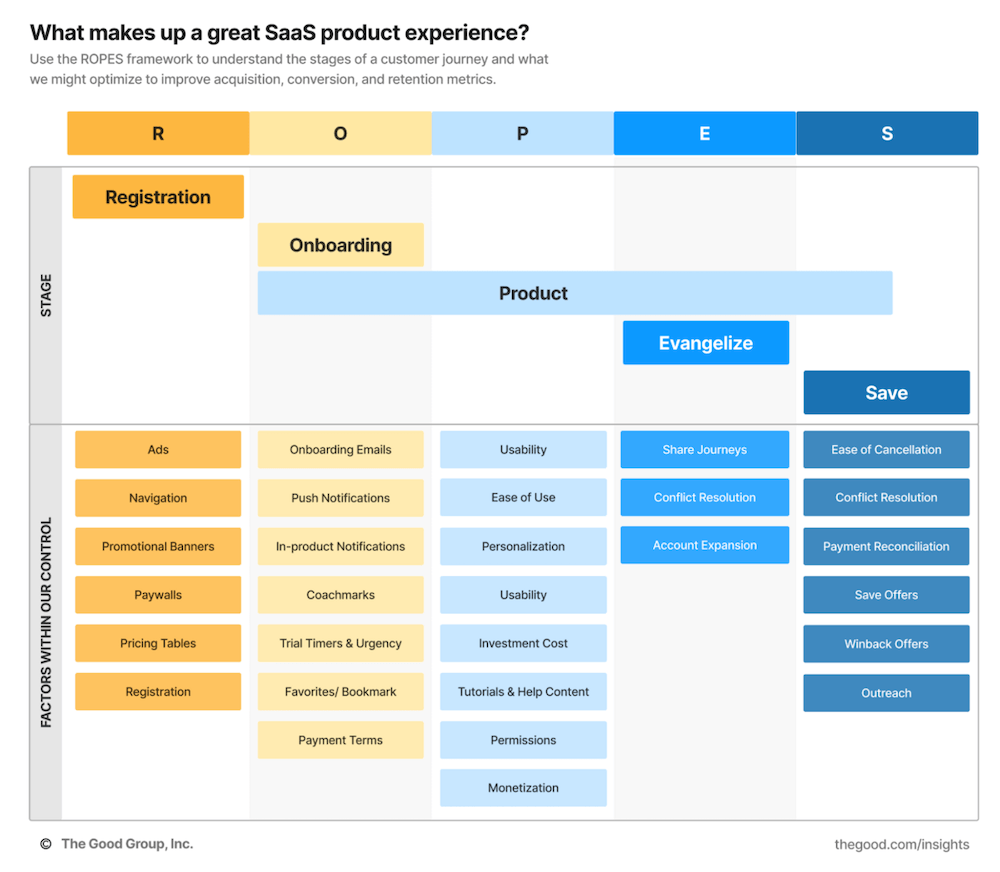
The framework matters here because most trial model decisions are made at the Registration level, then handed off to onboarding teams who weren’t part of the original conversation. What gets lost in that handoff is alignment on what “success” inside the trial window actually looks like, measured not in clicks or logins but in genuine product adoption.
Here’s how the ROPES stages map onto the three trial models:
Registration is where trial model choice is most visible. The SaaS trial model you choose shapes the offer users see, the urgency or lack of it in the signup experience, and the expectations they carry in with them. A free trial communicates a deadline. Freemium communicates openness. A reverse trial communicates premium access. These frames matter because users begin evaluating your product before they’ve touched it.
Onboarding is where trial models diverge most sharply in execution. ROPES defines this stage as the search for the “aha moment,” the point where users discover concrete value and feel pulled to continue. For a time-limited free trial, that moment has to arrive fast, ideally in the first three to five days. For freemium, onboarding can be more gradual, but needs to build toward habit rather than casual dipping. For a reverse trial, onboarding must specifically expose users to premium-tier functionality, because the entire model depends on users experiencing what they’ll eventually lose.
Product Experience is the longest stage and often the least well-designed one. This is where users engage repeatedly, where habits either form or don’t, and where the data on what’s working and what isn’t starts accumulating. ROPES emphasizes making the product easy to use and personalized to user needs during this stage, and for trial design specifically, it’s where feature gate decisions and upgrade prompts become critical. The product experience stage is where the ROPES metrics, daily active users, monthly active users, deeper feature adoption, and conversion to paid tiers become the most direct signal of whether your trial model is actually doing its job.
Evangelize is a stage most trial design conversations ignore entirely, but it’s directly relevant to building network effects. Free users share, invite, and create organic registration entry points. If your trial model is designed well, evangelism is built into the product loop itself. ROPES asks you to design, share, and invite touchpoints into the experience, not treat them as afterthoughts.
Save is the stage most trial architects hope never gets reached, but planning for it is part of responsible trial design. For freemium users, save thinking means having a clear story about what they’re downgrading from if they leave. For free trial users, it means having a clear win-back path if the trial ends without conversion. For reverse trial users, the downgrade itself is a save moment, a designed experience that should prompt upgrade rather than just silently limiting access.
The ROPES Framework doesn’t tell you which trial model to choose. But it gives you a structured way to audit whether your chosen model is actually set up to work, stage by stage, across the full customer journey. If you run your trial model choice through each of the five stages and find gaps, those gaps are where users will fall out.
What all three models share
Despite their differences, free trial, freemium, and reverse trial models all succeed or fail on the same underlying principle. They’re not just acquisition tools. They’re the first chapter of your onboarding story.
User-centered prioritization, building your trial experience around what users actually need to discover rather than what you want to demonstrate, is the foundation of all of it.
The trial model is architecture. Activation is execution. Both have to be right.
And no trial model has to be permanent. The most sophisticated SaaS companies treat their trial design as a living experiment, testing window lengths, tier structures, feature gate placement, and onboarding flows against real behavioral data.
Your current model is a hypothesis. The question is how quickly you can learn whether it’s the right one.
If you’re below a 20% feature adoption rate within trial periods, or your free-to-paid conversion consistently underperforms your category, the problem may not be your marketing or your pricing page. It may be the foundational model underneath them. That’s worth diagnosing before you optimize anything else.
The first 30 days as a complete system
Choosing the right trial model is the starting point, not the finish line. What happens across the full first 30-day arc of a user experience, the onboarding experience, the activation moments, the communication sequence, the conversion decision itself, involves every team from product to marketing to customer success, and most companies have never looked at it as a single connected system.
That’s the work we do. Rather than optimizing individual pieces in isolation, we map the complete user journey from signup through day 30, diagnose where users fall out and why, and build a research-backed roadmap for improving conversion and retention across the whole window. If your trial numbers are underperforming and you’re not sure where to look, that’s usually where the answer is.
The Good is a Digital Experience Optimization consultancy helping SaaS companies turn user behavior into growth. If you’re rethinking your trial model or onboarding architecture, our team is available to help.
About the Author
Jon MacDonald
Jon MacDonald is founder and President of The Good, a digital experience optimization firm that has achieved results for some of the largest companies including Adobe, Nike, Xerox, Verizon, Intel and more. Jon regularly contributes to publications like Entrepreneur and Inc.