
Not All Trial Users Are Equal: How To Use Onboarding Segmentation To Convert The Ones Who Matter
Your trial cohort is not a single audience, and the users most likely to convert are sending you signals from day one. Here's how to find them, understand their intent, and build an onboarding experience that responds to what they're actually trying to do.

Here’s a question most SaaS teams can’t answer cleanly: of the users who started a trial last month, what were they actually trying to accomplish?
Not their job title. Not their company size. What specific outcome did they show up hoping to get from your product?
If the honest answer is “we don’t really know,” there’s a problem. Because the users who converted and the users who churned almost certainly weren’t trying to do the same thing, and your onboarding flow treated them as if they were.
That’s the core argument for onboarding segmentation. Not that user segmentation is generally useful (it is), but that the trial window is one of the single highest-leverage moments to apply it.
The stakes are compressed, the signals are available early, and the cost of a generic experience is paid immediately in trial churn.
Why the trial window changes the segmentation equation
In a mature product, you have time to learn who your users are. Behavior accumulates. Patterns emerge over weeks and months. You can build segments retroactively and apply them to future cohorts.
In a trial, you don’t have that runway. 90% of users churn if they don’t find product value within their first week. Most users make their stay-or-go decision in the first session or two; the rest of the trial reinforces a conclusion they’ve already drawn.
That compression is what can make onboarding segmentation both more urgent and more tractable than segmentation in other contexts. Users who are actively evaluating a product are, by definition, generating intent signals in real time. They’re showing you exactly what they’re trying to accomplish through where they navigate, what they skip, how long they stay, and whether they come back.
The question isn’t whether your trial users are different from each other; they are. The question is whether you have a framework for reading those differences fast enough to act on them before the window closes.
What intent-based segmentation actually means
Most SaaS companies already do some form of user segmentation. They group users by company size, industry, subscription tier, or acquisition channel. These categories have their uses, but they share a critical limitation: they describe who users are, not what they’re trying to do.
Intent-based segmentation takes a different approach. Instead of grouping users by static attributes, it groups them by the goals and workflows that drive their behavior. The segment isn’t “enterprise user” or “marketing manager.” It’s something like: “user who is trying to coordinate a small team across daily task updates” or “user who is managing multiple client deliverables simultaneously and needs professional reporting.”
Those descriptions might sound like the same person as the enterprise marketing manager, or they might not. That’s the point. Job title and company size don’t tell you which one you’re dealing with. Behavior does.
In our work building intent-based user clusters for a leading enterprise SaaS company, this distinction turned out to matter enormously. The product served everyone from solo users to large enterprise teams, but the onboarding experience treated everyone the same.
Users logging in to track a single client project were being shown team collaboration features. Power users managing complex workflows couldn’t find the advanced capabilities they needed. Heavy feature usage, the metric the team had been watching, didn’t actually predict retention.
What mattered was whether the features a user engaged with actually matched what they were trying to accomplish.
Behavioral intent was the missing layer.
How to identify intent clusters during the trial window
The mechanics of intent-based segmentation are the same whether you’re applying them to a trial cohort or a mature user base, but the inputs and timeline are compressed. Here’s how the process works in the context of the first 30 days.
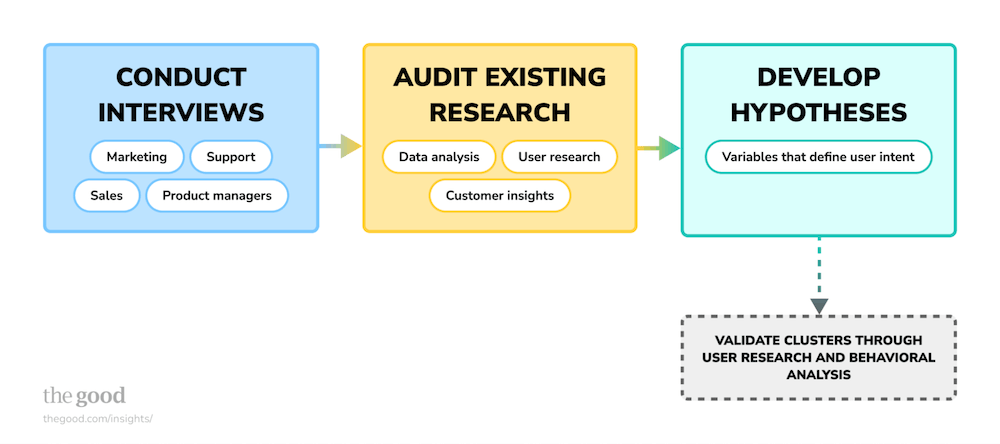
Start with what you already know
Before touching any data, consolidate the institutional knowledge that’s already in your organization. Your product team, customer success, sales, and support teams have all formed mental models of your users, and those models usually contain real signals even when they’re incomplete or contradictory.
Conduct short interviews with each team and ask the same questions:
- How do you describe different types of users?
- What patterns have you noticed in how different users engage in the first few weeks?
- Where do you see the biggest differences between users who convert and users who churn?
The contradictions between teams are as useful as the agreements. If product thinks new users are confused by the setup process but customer success thinks they’re actually getting through setup fine and churning later, that’s a hypothesis worth testing.
If marketing believes their ICP is enterprise procurement teams but sales says the users who convert fastest are solo operators, that gap is a segmentation problem.
Build provisional intent clusters from first-session behavioral data
Once you have a working hypothesis about why different users show up, look for behavioral evidence in your product analytics. The goal is to identify clusters of users who share similar patterns in how they navigate, what features they engage with in sequence, and where they drop off.
Some of the most reliable early signals:
Navigation path in the first session: Where do users go first, and how deep do they go before they leave? A user who navigates directly to a core functional area and attempts something real is signaling different intent than one who clicks through a product tour and exits.
Feature co-occurrence patterns: Which features appear together in the same sessions, and which clusters of features tend to predict return visits or conversion? In our client work, we found that the combination of features used mattered far more than the volume of features used. A user who engages with three features in a coherent workflow shows more retention potential than a user who clicks through ten features without a clear pattern.
Time-to-first-meaningful-action: How quickly does a new user accomplish something real in your product — not just completing an onboarding checklist, but taking an action that reflects their actual use case? Reducing the time it takes users to find value can increase customer satisfaction by 10–30%, with a direct impact on retention. Tracking this metric by emerging behavioral cluster tells you which intent types your current onboarding is serving well and which it isn’t.
Return behavior in the first 72 hours: Users who return quickly after a first session are confirming that something landed. Users who don’t return within a few days are signaling early churn risk, and in a trial window, early churn risk is the only kind that matters.
Cross-reference these behavioral signals against what you learned in your stakeholder interviews. Where the patterns align, you have the seeds of a validated cluster. Where they contradict your assumptions, you have a research question worth investigating.
Validate clusters through targeted user research
Behavioral data shows what users do. It doesn’t always explain why. Before you build onboarding experiences around your provisional clusters, run usability sessions and interviews with users who fit each behavioral profile.
For each cluster, you want to understand:
- What were they trying to accomplish when they signed up?
- What does success look like in their workflow?
- Which features feel relevant to their use case, and which feel like noise?
- What would make them cancel, and what would make them stay?
These conversations consistently surface things that analytics miss.
In our client engagement, we found that one cluster had fast initial adoption but plateaued quickly, not because the product wasn’t working for them, but because they’d found exactly what they needed and had no reason to explore further.
A different cluster showed slow initial adoption but deep long-term engagement because they needed time to build the product into their workflow before it delivered real value. Neither pattern was visible in the aggregate retention data.
The goal of this research isn’t to validate your assumptions; it’s to stress-test them. A cluster that holds up under both behavioral analysis and qualitative interviews is one you can build onboarding experiences around with confidence.
Define behavioral flags that identify each cluster early
The practical challenge of trial-window segmentation is speed. You need to know which cluster a user belongs to early enough to serve them a differentiated experience, ideally within the first few sessions, not after two weeks of data collection.
This requires defining a minimum viable set of behavioral flags that reliably predict cluster membership. The flags should be early-appearing, observable without any user action, and validated against the retention outcomes you care about.
For one cluster in our client project, the relevant flags included: creating a certain number of tasks in the first week, returning on multiple separate days within the first two weeks, and consistently using a specific view type while rarely engaging with advanced features. That combination predicted 40% higher 90-day retention than average, regardless of company size or job title, which had no meaningful predictive power.
For a different cluster, the flags looked completely different: creating multiple separate projects in the first few days, engaging with organization and permissions features early, and spending significantly longer in each session.
Your flags will be specific to your product and your users. The methodology transfers; the specific signals don’t. That’s a feature, not a limitation. It means the clusters you find are real patterns in your actual user behavior, not archetypes borrowed from somewhere else.
From clusters to onboarding decisions
Once you have validated clusters and early behavioral flags, the segmentation work becomes actionable. The question shifts from “who are these users?” to “what should their first 30 days look like?”
Onboarding sequences: Onboarding can be tailored to surface the features and workflows that match each cluster’s intent rather than walking everyone through the same generic product tour. A user whose behavioral flags suggest they’re trying to manage multiple client deliverables doesn’t need a tutorial on daily standup workflows and vice versa.
In-app messaging: Trigger messaging by behavioral context rather than elapsed time. When a user who matches a specific cluster profile takes an action that suggests they’re ready for the next step in their workflow, that’s when to surface the relevant feature, not on day three because that’s when the email sequence fires.
Upgrade paths: Reflect cluster-specific value propositions in your upgrade path. Pushing team collaboration features to a user who is clearly working solo, or pushing solo-productivity features to a user who is trying to coordinate a team, isn’t just ineffective; it signals that the product doesn’t understand what they’re there for.
Early intervention: For users showing churn-risk signals, early intervention becomes much more precise. Instead of a generic re-engagement campaign, you know which cluster a user belongs to and what would actually bring them back.
One thing worth flagging: the first version of your segmentation model will be imperfect. Clusters will shift as you gather more data. Flags that seem predictive will turn out to be noise. The value isn’t in building a perfect segmentation model on the first pass; it’s in building a feedback loop that gets more accurate over time, using real trial behavior as the input.
The cross-functional problem you also need to solve
Onboarding segmentation surfaces a structural issue most teams overlook. The first 30 days are treated as a product problem, but in practice, the trial window spans completely separate organizational worlds.
Marketing owns everything that happens before a user signs up, including the messaging, the positioning, and the expectations that bring someone to “Start Free Trial” in the first place. Product owns everything that happens after. And the gap between those two worlds is rarely owned by anyone.
The result is that most SaaS companies don’t have a shared picture of what the first 30 days actually looks like end-to-end. Marketing is optimizing for signups without knowing which expectations those signups arrive with. Product is optimizing for activation without knowing whether the experience is validating or quietly undermining what marketing promised. Customer success is watching churn happen without enough upstream context to understand why. Each team has a piece of the arc, but none of them has the whole thing.
Intent-based clusters help bridge that gap because they create a shared language. When marketing, product, and customer success are all working from the same cluster definitions and behavioral flags, they can have coherent conversations about which segments are converting, which aren’t, and whether the problem is upstream (the wrong users are being attracted) or downstream (the right users aren’t finding value fast enough).
That alignment is harder to build than the segmentation model itself. But without it, the segmentation work tends to stay inside one team and lose most of its leverage.
Where to start
If intent-based onboarding segmentation is new to your team, the entry point is simpler than it might look.
Pull your trial cohort from the last 90 days and separate converters from churners. Then go back and look at first-session behavior for both groups. In almost every case, the behavioral differences are visible within 48 hours of signup; you just need to know what to look for.
That analysis is the foundation of your first provisional cluster model. Pair it with a handful of user interviews across both groups, and you’ll have enough to define your initial behavioral flags and start building differentiated onboarding experiences.
The goal isn’t to build a perfect segmentation system before you act. It’s to stop treating every trial user the same because the cost of that assumption shows up every month in conversion rates, and it’s a problem you can solve.
If you want help building the research foundation for intent-based onboarding segmentation, The Good’s team works with SaaS companies on exactly this kind of work.
About the Author
Caroline Appert
Caroline Appert is the Director of Marketing at The Good. She has proven success in crafting marketing strategies and executing revenue-boosting campaigns for companies in a diverse set of industries.