
When Your Product Is The Sales Team, The First 30 Days Of The User Experience Are Your Sales Cycle
In product-led growth, the first thirty days of the user experience are your relationship-building sales team.

In product-led growth, the product sells itself. Free trials, frictionless onboarding, viral expansion mechanics. The strategy is proven. Canva, Zoom, Slack, and Dropbox have all used their products as their primary growth engine, and the SaaS world has largely followed their lead.
But having a product-led strategy is not the same as having a product that actually leads growth. The strategy gets you to the door. What happens inside, in those first thirty days, determines whether users walk through it or walk away.
This article is about The First 30. The period from initial sign-up through habit formation, activation, and the conversion moment itself. In a product-led model, this window is not one phase of the sales process. It is the sales process. And it deserves the same rigor you would give any high-stakes sales cycle.
The product is the sales team. Is it performing?
In a traditional SaaS model, the sales team handles objections, builds urgency, personalizes the pitch, and guides the prospect toward a decision. A skilled rep can recover from a weak first impression, tailor messaging to specific pain points, and follow up when interest starts to wane.
In a PLG model, the product does all of that. Or it does not.
The difference matters because users in a product-led environment are making their own decisions, on their own timeline, with only the experience in front of them to guide them. There is no rep to call and ask, “Just checking in, where are you in your evaluation?” There is only what the product reveals or fails to reveal about its own value.
Over half of all downloaded apps are uninstalled within the first thirty days. Studies consistently show that close to 80% of free trial users never convert to paying customers. These are not primarily pricing problems or positioning problems. They are product experience problems rooted in one core failure: users never got far enough into the product to understand why it was worth paying for.
What makes the first 30 different from everything that follows
Before digging into how to optimize The First 30, it helps to understand why it is structurally different from the rest of the user lifecycle.
After conversion, users who stay are users who have already found value. They have developed workflows. They know where things are. The product has earned a place in how they work. Improvements at this stage matter, but the user has cleared the hardest hurdle.
The First 30 is different because users are evaluating the product in real time, often unconsciously. They are not asking “how do I get more out of this?” They are asking, “is this worth my time?” That is a different question, and the product experience needs to be designed to answer it convincingly, quickly, and without the user having to ask.
The trial model shapes a significant part of this dynamic. A time-limited free trial creates urgency through loss aversion. A freemium model relies on habit formation and the endowment effect. A reverse trial, which gives users full access before stepping them down, creates a concrete sense of what they stand to lose by not converting.
Each creates a different psychological arc across the first thirty days, and the product experience has to be designed to fit the model, not layered on top of it as an afterthought.
No matter the model, the goal is the same: help users reach a meaningful outcome before the window closes.
The ROPES framework gives product-led teams a way to map that work across the full customer journey, and to understand exactly where The First 30 sits within it.
The ROPES framework maps the territory
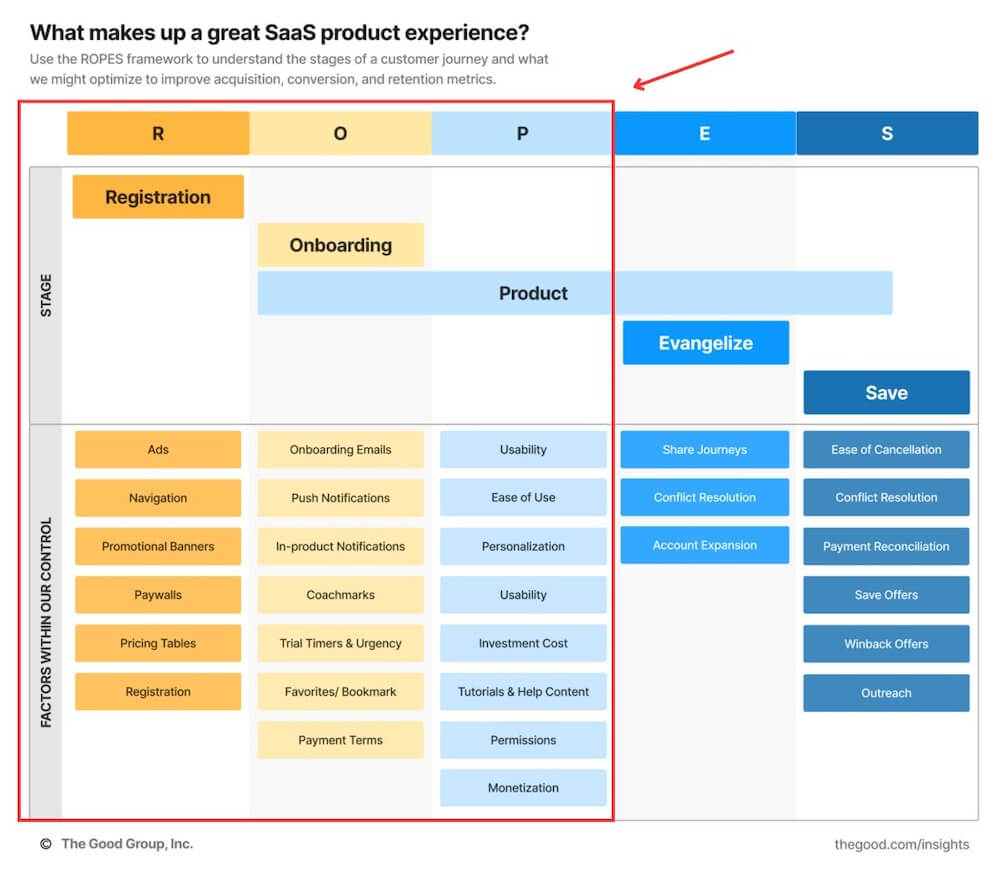
For teams that want to get serious about the first thirty days, it helps to look at The First 30 through the lens of our ROPES framework: Registration, Onboarding, Product, Evangelize, Save.
The First 30 primarily lives in the first three stages. Registration, Onboarding, and the early Product experience are where the conversion decision gets made. Evangelize and Save are real and important stages of the customer journey, but they come after users have found value and crossed the conversion threshold. You cannot evangelize a product you have not yet committed to. You cannot be saved from churn you have not yet experienced.
That means the handoff matters. The goal of a well-optimized First 30 is to get users to a place where Evangelize and Save become relevant problems, which is a better problem to have than churn before conversion. But it also means that teams sometimes invest in retention and referral mechanics before they have solved the more fundamental issue of activation.
With that framing in mind, here is how the first three stages of ROPES shape The First 30.
Registration
Registration is where users decide whether the product is worth trying. Friction here is invisible cost. Every extra field, every confusing pricing page, every unclear value proposition is a user who did not sign up. The goal is to reduce barriers and set accurate expectations, because users who sign up based on an overinflated promise will not convert, even if the product is excellent.
Onboarding
Onboarding is where the real work of The First 30 begins. This is where users either find their “aha” moment or start drifting toward churn. The aha moment is not a feature; it is the instant a user realizes the product can do something meaningful for them. Getting users to that moment quickly is the single highest-leverage thing most PLG teams can do. Coachmarks, trial timers, push notifications, in-product guidance: these are the tools, but they only work when they are designed around what users actually need to experience first, not what teams want to show them.
Product
Product is where retention is built. Once users have found initial value, the product stage is about deepening that relationship. Ease of use, feature discoverability, personalization, and investment cost all determine whether users move from “this is interesting” to “this is how I work.” The teams that get this right are usually the ones running continuous research, not just post-launch surveys.
Time-to-value is the number that matters most
Of all the metrics product teams track in the first thirty days, time-to-value (TTV) is the one with the clearest connection to outcomes. Reducing the time it takes a user to experience meaningful value from your product can improve customer satisfaction by 10% to 30%, with direct downstream effects on retention and conversion.
There are a few principles that hold across product types when it comes to accelerating TTV.
Slow drip information
The impulse to show users everything the product can do immediately is understandable, but counterproductive. Dumping features and options on a new user does not demonstrate value. It creates cognitive overload and delays the moment when users feel confident enough to explore on their own. Trickle information in a sequence that maps to what users need to succeed, not what teams want to promote.
Design for quick wins
Quick wins are small actions users can complete in the first session that give them a tangible sense of progress and competence. They work because of a real psychological dynamic: when users feel successful early, they are more motivated to continue. The first win does not have to be the product’s flagship feature. It just has to be real.
Put the user first
The best onboarding experiences are built around a clear understanding of who is signing up and what they are trying to do. Segment new users by intent or use case, and design onboarding flows that speak to their specific goals. Generic onboarding that says “here is everything” is speaking to no one in particular.
Give clear step-by-step guidance
New users should never have to guess what to do next. In-product guidance, clear progress indicators, and contextual prompts at decision points reduce the cognitive effort of learning a new tool. When users have to figure things out on their own, many of them simply do not.
Why most teams miss opportunities in The First 30 of PLG
For all the attention given to the PLG strategy at the macro level, The First 30 is often where execution falls apart. There are a few reasons for this.
First, The First 30 is cross-functional territory. Product owns the in-product experience. Marketing owns the registration flow and onboarding emails. Customer success often owns activation. When accountability is fragmented across teams, optimization tends to happen in silos rather than as a coordinated effort across the full user journey.
Second, teams often treat The First 30 as a launch problem rather than an ongoing optimization problem. They design an onboarding flow, ship it, and move on. But user behavior changes, the product evolves, and what worked at launch may stop working six months later. The teams that stay ahead of churn are the ones running continuous research, not just post-launch check-ins.
Third, many teams are still operating on a “launch and learn” philosophy rather than a “test and learn” approach. They build based on assumptions about what users need, ship, and then analyze results. In a PLG model, this is especially costly because the product experience influences every KPI from acquisition to retention. When you launch first and learn later, you are gambling with the user relationship at its most fragile moment.
The shift to “test and learn” means experimentation happens before changes go live, not after. It means validating hypotheses about onboarding flows, time-to-value mechanics, and feature discovery with real users before committing to full implementation.
The First 30 is where PLG either compounds or collapses
There is a compounding effect built into a well-optimized First 30. Users who activate are more likely to convert. Users who convert are more likely to expand. Users who expand are more likely to evangelize. Every improvement to the early experience ripples forward through the entire customer lifecycle.
The reverse is also true. A poor first thirty days does not just end in churn. It means the acquisition cost of bringing that user in generates no return. It means the product’s reputation takes a hit through passive abandonment and, occasionally, active word-of-mouth. In a growth model that depends on the product to sell itself, the cost of a bad first impression is higher than it appears on any single dashboard.
The good news is that The First 30 is highly improvable. It is well-defined, measurable, and bounded in a way that makes experimentation tractable. Teams that commit to understanding what their users actually experience in those first thirty days, through real research, behavioral data, and systematic testing, consistently find meaningful improvements that move the metrics that matter.
Where to start
If your conversions or retention are not where you want them, The First 30 is the most likely place the opportunity is hiding.
Start by mapping the actual user journey from registration through the first conversion moment. Not the journey you designed, but the journey users are actually taking. Where do they get stuck? Where do they drop off? Where do they find value? Behavioral analytics can tell you what users are doing. Qualitative research can tell you why.
Then look at your onboarding sequence with fresh eyes. Is it designed around what users need to experience first, or around what the team wants to show? Is there a clear, early win built into the first session? Is time-to-value being actively tracked and optimized, or just observed?
Finally, ask whether the teams that own different parts of The First 30 are working toward a shared goal. If registration, onboarding, and early product experience are each optimized in isolation, you are likely leaving significant conversion on the table.
The product is the sales team. Every time a new user signs up, every day of their first thirty days, it is either earning the conversion or losing it. The question is whether your team is actively coaching it or hoping it performs on its own.
The Good helps SaaS product and growth teams optimize the full first 30 days of the user experience, from registration through activation and conversion. If you are seeing high sign-up volume but lower-than-expected conversion, or users who activate but never expand, we can help you understand why and build the research and experimentation practices to fix it. Let’s talk.
About the Author
Jon MacDonald
Jon MacDonald is founder and President of The Good, a digital experience optimization firm that has achieved results for some of the largest companies including Adobe, Nike, Xerox, Verizon, Intel and more. Jon regularly contributes to publications like Entrepreneur and Inc.