5-Minute Website Assessment Based on 16+ Years of Optimization Data
Revenue Opportunities Hidden in
Warby Parker's User Experience
3 Free Data-Backed Website Optimization Opportunities
We analyzed Warby Parker's digital experience using our proprietary database of 2,000+ tests, 10,000+ research data points, proprietary frameworks, and initial research methods. Now we've identified $18.4M in potential revenue improvements.
Our Methodology
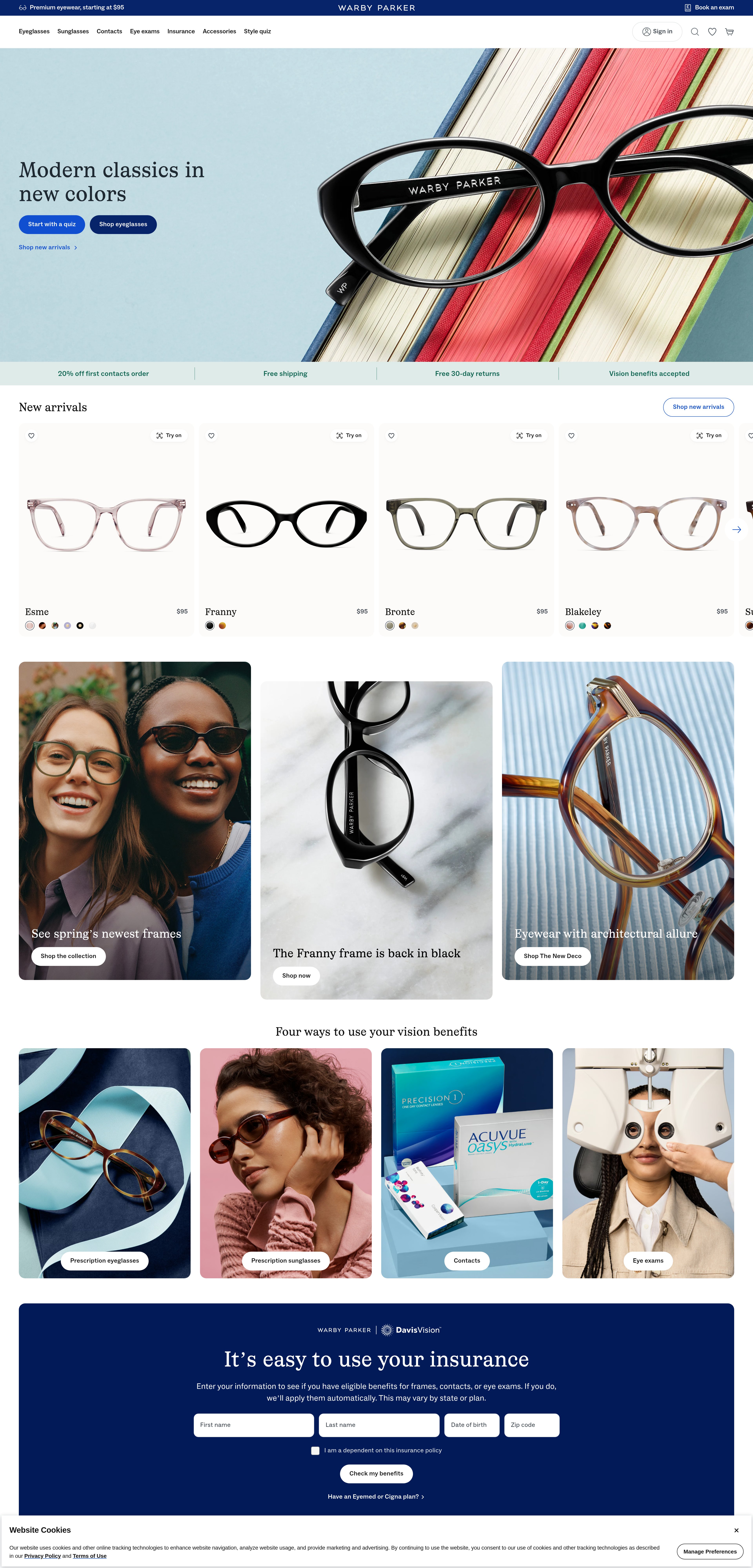
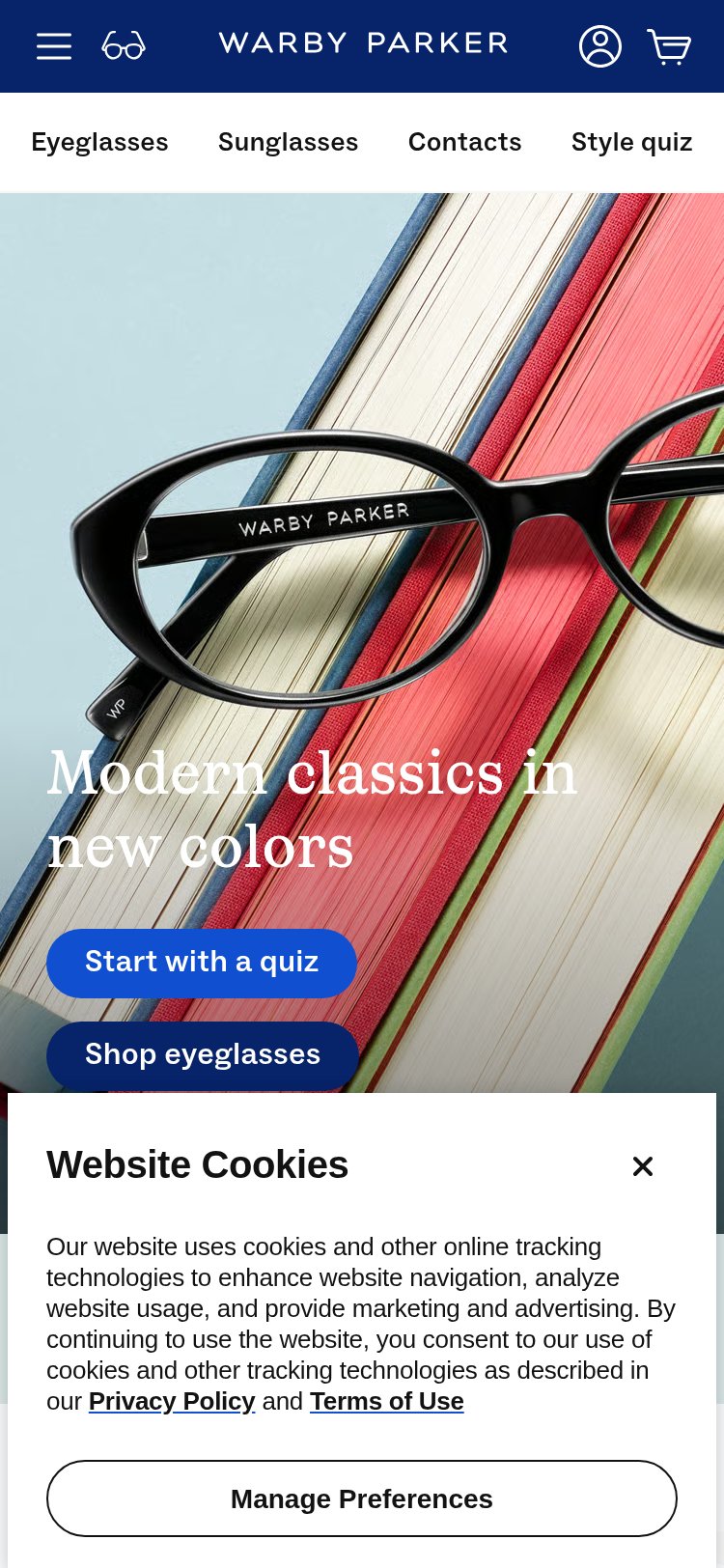
To create this analysis, we:
- Analyzed your website's user experience patterns
- Compared against 200+ similar Retail - Eyewear/E-commerce companies in our database
- Applied our DXO Heuristics framework
- Generated real-time heatmap data
- Cross-referenced with test results from past clients facing similar challenges
How we calculate revenue projections
Revenue projections are calculated using public estimates of your annual revenue, the conversion contribution of each page type, historical lift percentages from our database of thousands of experiments, and a confidence multiplier based on evidence strength. Total projected impact is capped at a percent of annual revenue to ensure conservative estimates.
Where Warby Parker's Visitors Are Actually Looking
We used AI-powered attention prediction to understand how visitors perceive your page at first glance. Red areas indicate where visitors focus their attention most.
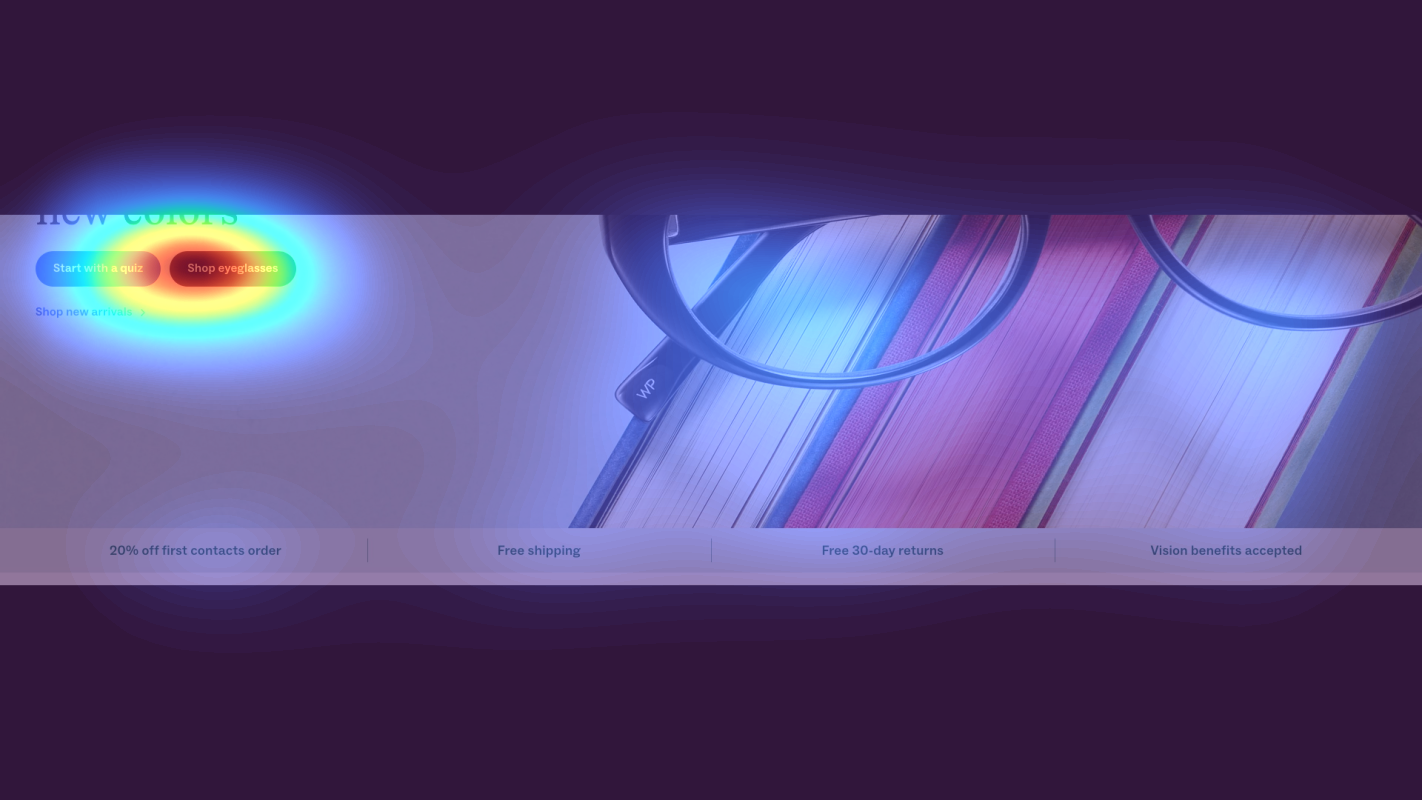
Hero section with large lifestyle image and minimal text overlay
The heatmap shows intense red/orange attention on the large hero image occupying the top viewport, but the heat is diffused across the entire image rather than concentrated on any actionable element. Navigation receives moderate yellow attention, but no clear focal point guides users toward conversion actions.
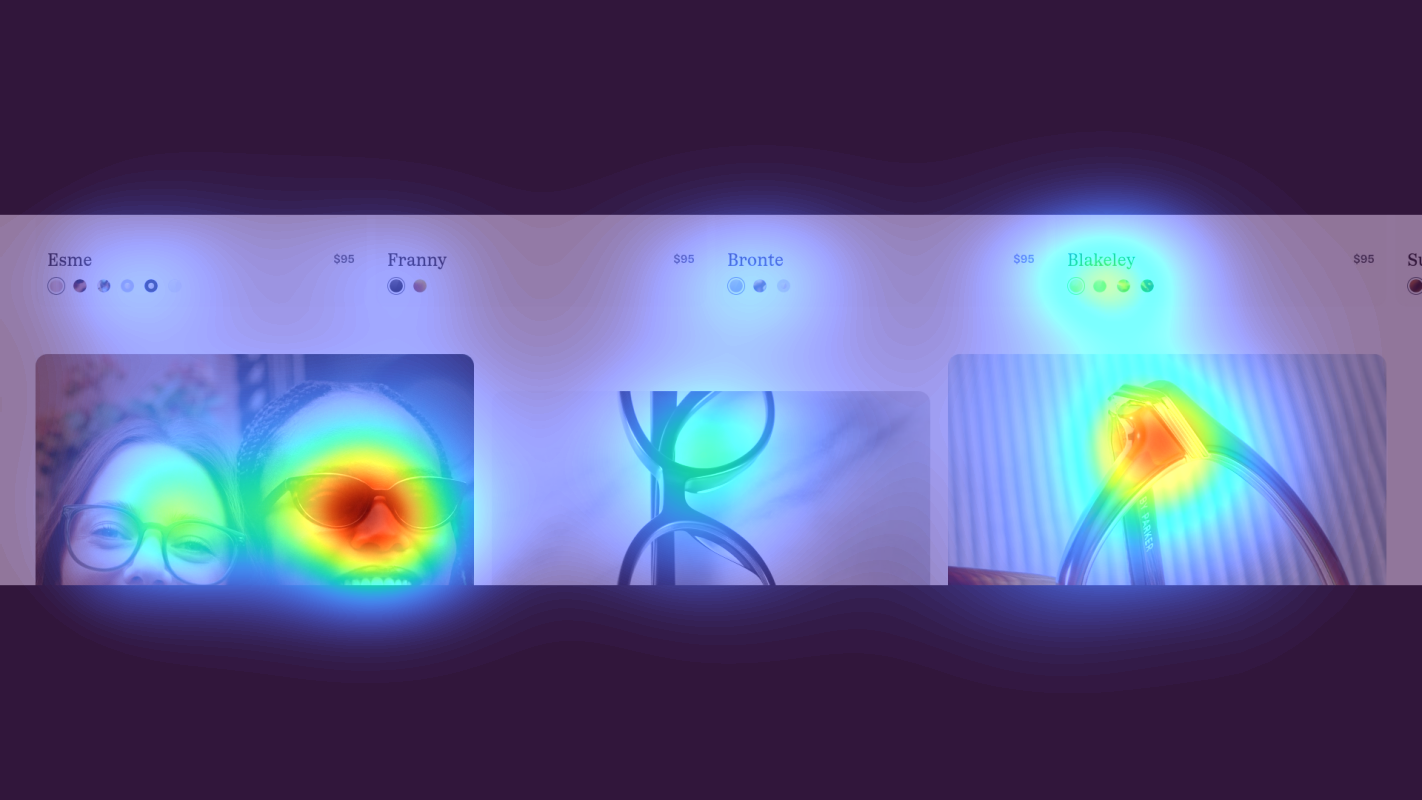
Product category grid with eyewear collections displayed in a 2x2 layout
The heatmap shows scattered yellow and green attention across product category tiles, with no single tile achieving strong red/orange heat. Attention is fragmented equally across all options rather than being guided toward a recommended starting point or best-seller.
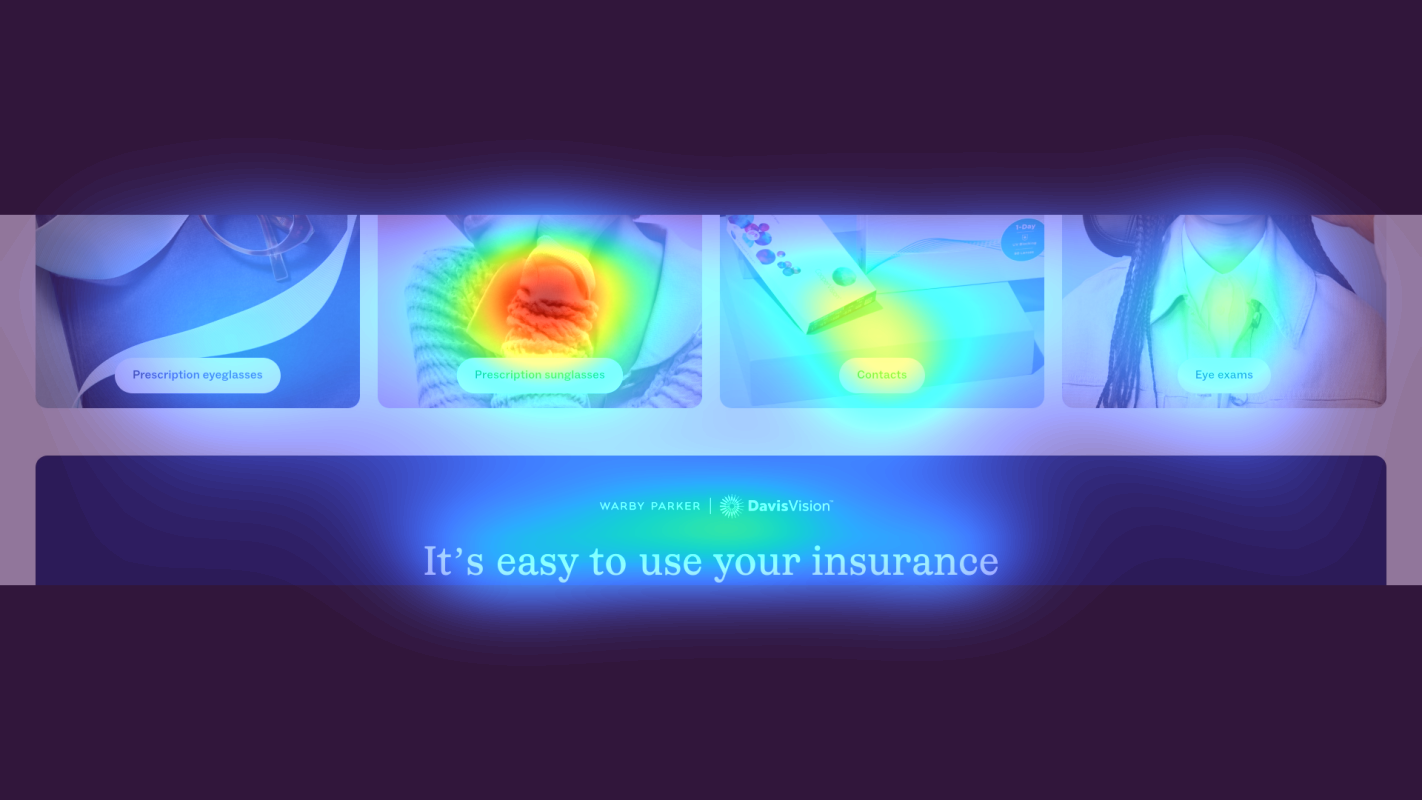
Customer testimonials and review section with star ratings and quote cards
The heatmap shows solid blue/green coloring across the testimonial section with virtually no red or orange heat, indicating users are not scrolling deep enough to see customer reviews, star ratings, or social proof that could overcome purchase hesitation.
3 Critical Issues Affecting Warby Parker's Conversions
Issue: Add High-Contrast CTA and Value Proposition to Hero Section
The hero section captures strong visual attention with its lifestyle imagery, but lacks any clear call-to-action or value proposition to convert that attention into action. Users are engaged with the image but have no obvious next step, leading to passive browsing without conversion intent. The navigation receives some attention, but no element in the hero guides users toward trying on glasses or shopping collections.
Issue: Implement Visual Hierarchy in Product Category Grid
The product category grid displays eyewear collections with equal visual weight, creating decision paralysis. Heatmap data shows attention fragmented evenly across all tiles with no single category achieving strong focus. Without a recommended starting point or clear hierarchy, users face high cognitive load trying to determine which option is right for them, leading to analysis paralysis and potential abandonment.
Issue: Surface Customer Reviews and Star Ratings Higher on Page
Critical trust-building content including customer testimonials, specific product feedback, and aggregate star ratings receives virtually no attention because it's positioned too far down the page. The heatmap shows minimal engagement with the testimonial section, meaning first-time visitors are leaving without seeing the social proof needed to overcome skepticism about purchasing eyewear online—a high-consideration, high-risk category.
3 Specific Changes That Could Increase Revenue by $18.4M
Recommendation 1: Add High-Contrast CTA and Value Proposition to Hero Section
The hero section captures strong visual attention with its lifestyle imagery, but lacks any clear call-to-action or value proposition to convert that attention into action. Users are engaged with the image but have no obvious next step, leading to passive browsing without conversion intent. The navigation receives some attention, but no element in the hero guides users toward trying on glasses or shopping collections.
Add a prominent, high-contrast CTA button (e.g., 'Shop Eyeglasses' or 'Start Your Home Try-On') positioned in the center-right portion of the hero where natural eye movement lands. Place a concise value proposition directly above the CTA—'Free Home Try-On • Free Shipping • Free Returns'—to immediately communicate Warby Parker's unique selling points. Use size, color contrast (likely a bold blue or contrasting color), and whitespace to make the CTA the dominant focal point in the hero, pulling attention away from passive image viewing toward conversion action.
In our tests, above-the-fold CTA optimization averages 9.8% lift across 25 tests. By adding a clear directional cue in the high-attention hero zone, we convert passive image engagement into purposeful action. The value proposition primes expectations about the try-on experience, reducing purchase anxiety for first-time eyewear buyers. This addresses the critical gap between visual engagement and conversion intent.
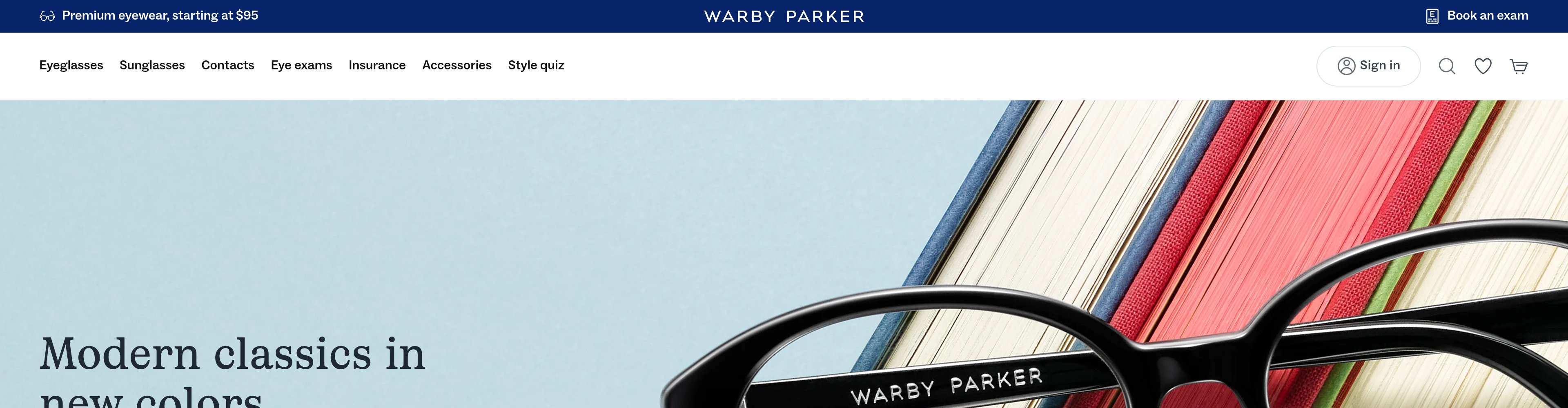
Recommendation 2: Implement Visual Hierarchy in Product Category Grid
The product category grid displays eyewear collections with equal visual weight, creating decision paralysis. Heatmap data shows attention fragmented evenly across all tiles with no single category achieving strong focus. Without a recommended starting point or clear hierarchy, users face high cognitive load trying to determine which option is right for them, leading to analysis paralysis and potential abandonment.
Create visual hierarchy by featuring one category as 'Most Popular' or 'Bestseller' with a 50% larger tile size and a subtle badge or label. Add social proof to the recommended option—'10,000+ 5-star reviews' or 'Our #1 Bestseller'—to guide uncertain visitors. Alternatively, add a 'Not sure where to start? Take our style quiz' CTA positioned prominently above the grid to offer a personalized recommendation path for indecisive shoppers. This gives users two clear paths: follow the crowd to the bestseller, or get personalized guidance.
In our tests, navigation and category hierarchy improvements average 9.4% lift across 32 tests. By breaking the pattern of equal visual weight, we reduce cognitive load and guide users toward a confident first choice. The social proof leverages bandwagon effect to overcome decision paralysis, while the quiz option provides an escape hatch for users who need more guidance. This directly addresses the scattered attention pattern by creating a clear focal point.
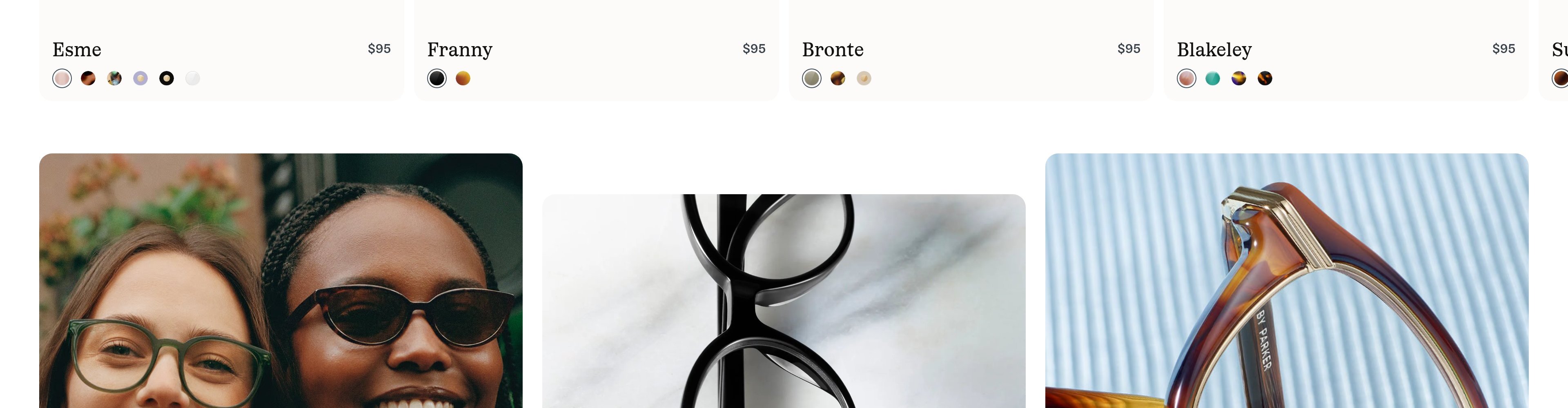
Recommendation 3: Surface Customer Reviews and Star Ratings Higher on Page
Critical trust-building content including customer testimonials, specific product feedback, and aggregate star ratings receives virtually no attention because it's positioned too far down the page. The heatmap shows minimal engagement with the testimonial section, meaning first-time visitors are leaving without seeing the social proof needed to overcome skepticism about purchasing eyewear online—a high-consideration, high-risk category.
Move a condensed review summary ('4.8★ from 15,000+ customers' or similar) directly below the hero CTA as a trust badge to immediately establish credibility. Create a horizontal scrolling carousel of 3-4 top customer reviews with photos, positioned immediately after the product category grid. Add star ratings and review counts to individual product category tiles ('4.7★ • 3,200 reviews') to surface social proof at the exact moment users are evaluating options. This multi-layer approach ensures trust signals appear at every decision point.
In our tests, trust signal optimization averages 4.8% lift across 21 tests. For eyewear—a category with high perceived risk when buying online—social proof is critical to overcoming purchase hesitation. By surfacing reviews earlier and at multiple touchpoints, we address the trust deficit before users leave the page. The current placement below the fold means this persuasive content never reaches most visitors, leaving money on the table.
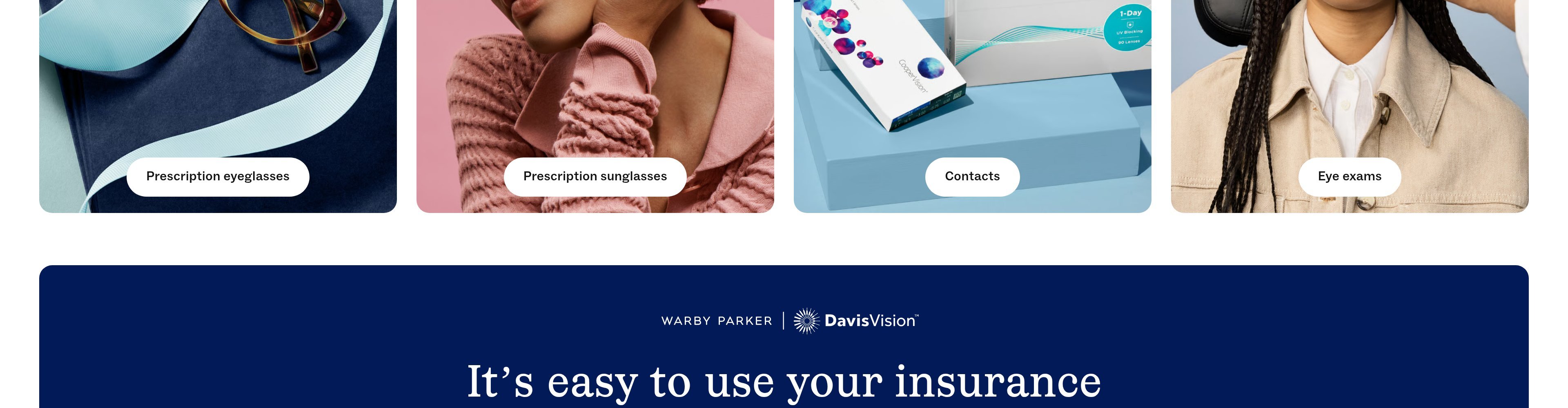
Combined Impact: Here's What Warby Parker Could Achieve
A conservative projection based on our methodology
Breakdown by Change
- Add High-Contrast CTA and Value Proposition to Hero Section $510.0K/mo
- Implement Visual Hierarchy in Product Category Grid $510.0K/mo
- Surface Customer Reviews and Star Ratings Higher on Page $510.0K/mo
How Warby Parker Would Work With The Good
Our approach lets your team validate our methods before a larger digital experience investment.
Discovery & Baseline
Deep-dive into your analytics and user behavior
Goal Setting
Define success metrics and KPIs
Sprint Planning
Prioritize tests by impact and effort
A/B Testing
Execute, measure, and iterate
Ready to Capture That $18.4M in Revenue?
This is an initial AI-driven assessment to illustrate revenue potential. The next step is a comprehensive optimization program built for you. Every optimization program starts with a digital experience audit. During the audit our team of experts:
- Conducts in-depth user research and analytics review
- Performs heuristic evaluation of your complete funnel
- Identifies the biggest conversion barriers and opportunities in your digital experience
- Creates a prioritized roadmap based on impact and effort
Why Warby Parker Should Trust This Analysis
16+ Years Optimization Work
We've optimized hundreds of millions in revenue through our optimization programs.
Fortune 500 Clients
Worked with leading companies including Nike, Adobe, and Xerox.
Data-Driven Methodology
Our analysis is based on thousands of successful A/B tests across industries.