IDEO U Improved The Path To Purchase For Their Online Learning Experience
See how IDEO U improved course discovery and the enrollment experience with our Digital Experience Optimization Audit™.

Overview
IDEO U is the online learning platform of IDEO, a globally renowned design company that pioneered design thinking.
As an extension of IDEO’s expertise, the platform offers courses and certificates in design thinking, creative leadership, and innovation methodologies for professionals seeking to enhance their problem-solving skills.
IDEO U delivers both self-paced and cohort-based learning experiences led by IDEO’s experienced practitioners. Their premium educational offerings, priced in the $300-500 range, target mid-career professionals looking to advance through practical design skills.
With their unique position as creators of design thinking methodology, IDEO U has established itself as an authority in the design education space.
The Challenge
IDEO U understood the value of fresh eyes and user research. Sometimes the expertise that makes you an authority in your field can make it harder to see your own blind spots. So, IDEO U approached The Good seeking an outside perspective on their online course platform’s conversion performance.
They were experiencing challenges with:
- Visitors not converting from high-traffic landing pages
- A confusing course discovery experience
- An unnecessarily complicated purchasing process for certificate programs
Data revealed the scale of the opportunity: traffic from organic “design thinking”-related keyword searches, a significant source of traffic, were converting at just 0.07%.
We hypothesized that their site wasn’t effectively communicating how courses were delivered or what value learners would gain, making it difficult for prospects to understand if IDEO U’s offerings were right for them.
The Process
After establishing a good mutual fit, The Good recommended the Digital Experience Optimization Audit™. The process began with comprehensive research, including analytics analysis, heat mapping, session recordings, and user testing to understand where the experience was breaking down.
Our analysis uncovered several opportunities for improvement:
Navigation and course discovery challenges
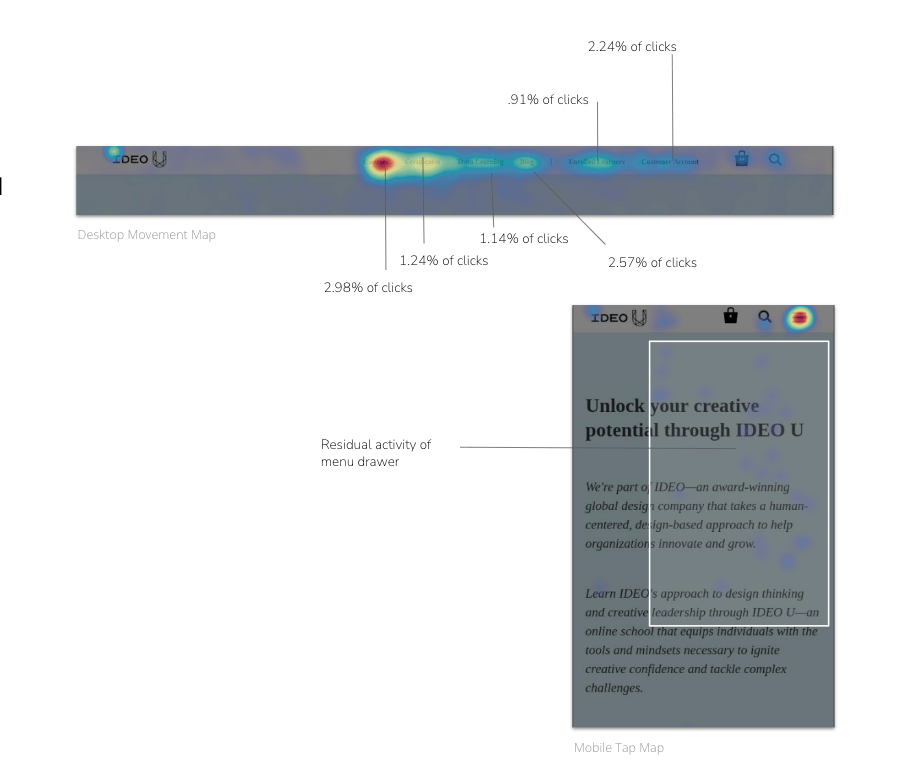
Heatmaps and session recordings identified user friction points, showing visitors clicking on non-interactive elements and struggling to find essential information. Users were looking for more information on the course, but not finding it where they expected.
The site categorized courses by delivery method (“on demand” vs “multi-week”) rather than by user intent, making it difficult for visitors to find relevant courses. Navigation labels weren’t intuitive or mutually exclusive.
Lack of outcome-focused messaging
Course pages were information-dense but didn’t clearly communicate career benefits or learning outcomes, especially important for early-career professionals evaluating their investment.
Unclear delivery and logistics
The team conducted targeted user testing with adults aged 25-45 who actively sought learning opportunities. These tests revealed confusion about course delivery methods.
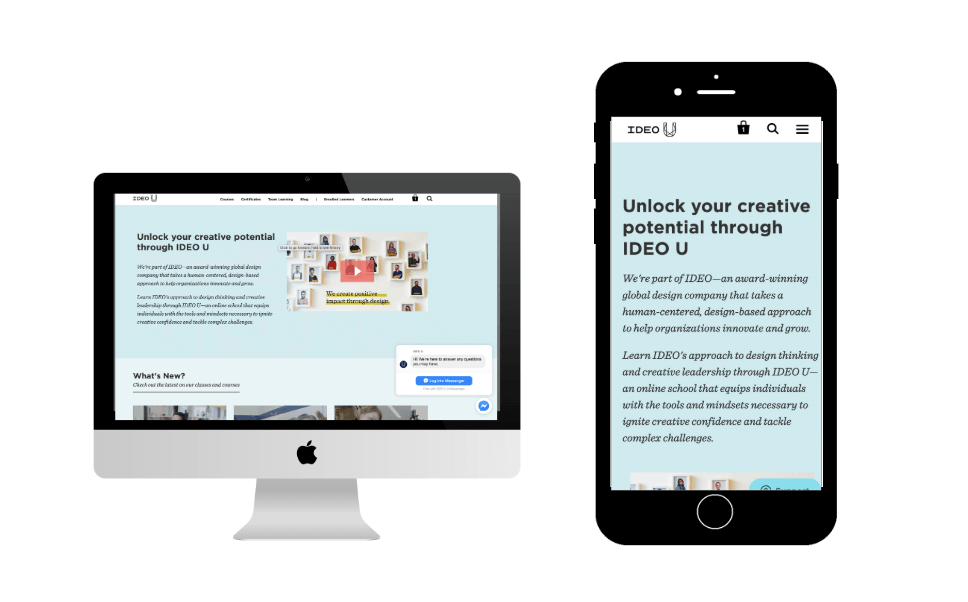
Visitors couldn’t determine how courses were actually delivered (synchronous vs self-paced), what the time commitment was, or how coursework functioned. The site showed images of in-person classroom learning despite being an online platform.
Complicated certificate purchasing
Learners had to add multiple courses individually, rather than being able to purchase certificate bundles, with no discount incentive or clear value proposition for the bundled experience.
Poor mobile experience
The mobile experience was clunky despite an increase in paid social traffic driving mobile users to the site.
Missed opportunities for trust-building
Course reviews were buried low on pages, instructor credentials weren’t emphasized, and social proof was underutilized despite IDEO’s strong reputation.
The Solution
These opportunities informed the next step in our process. We had methodically assessed the entire customer journey, from initial site visit through enrollment and course completion, to create a foundation for a strategic roadmap organized by implementation priority and impact potential.
Key recommendations included:
Streamlined course discovery
We offered recommendations to reorganize navigation by topics and outcomes rather than delivery format, add filtering by experience level (beginner/intermediate/advanced), and include “best seller” or “most popular” flags to help users make confident decisions.
Enhanced course pages
We suggested they add critical details like course duration, instructor credentials, student count, and clear expectations about coursework and time commitment. Our research also suggested that replacing classroom imagery with visuals that accurately represent the online learning experience would support a better understanding of the offering from customers.
Certificate bundling
Our team suggested they create unified certificate products that could be purchased together, with clear pricing, discount incentives, and outcome-focused messaging about the certification value.
Trust and urgency elements
Surface course reviews more prominently, add countdown timers showing when courses start to create urgency, and leverage IDEO’s reputation through strategic social proof placement.
The Results
Following the audit, IDEO U implemented major improvements addressing its core conversion barriers:
Homepage transformation
They added outcome-focused value propositions in the hero section that clearly communicated career benefits, addressing the lack of clear messaging about what learners would gain.
Certificate bundling implemented
IDEO U created unified certificate products that could be purchased as a package rather than adding individual courses, streamlining the path to purchase.
Trust signals added
Their team incorporated prominent social proof sections throughout the site, leveraging IDEO’s strong reputation more effectively.
Urgency messaging
They incorporated countdown timers showing when courses start (e.g., “Starting in 17 days”), creating a sense of urgency while providing helpful planning information.
A second audit
The team was so pleased with the results from the first audit that they returned for a second audit when their business strategy evolved. IDEO U had shifted its acquisition approach with increased investment in paid social campaigns, which brought a different type of visitor to the platform.
Where the first audit addressed high-intent organic visitors who already knew IDEO and were searching for design thinking courses, the second audit tackled a new challenge: converting top-of-funnel paid social traffic. These mobile-heavy audiences needed more trust-building and a different approach to engagement. New recommendations for this evolved audience included:
- Mobile-optimized lead capture (like “download syllabus” CTAs that collect emails before enrollment)
- Personalized homepage experiences for returning visitors
- Landing page customization based on traffic source
The two audits established a foundation for IDEO U to continue iterating on its digital experience based on data rather than assumptions, demonstrating that optimization is an ongoing practice that evolves as acquisition strategies and audiences change.
How IDEO U Improved Path To Purchase By Working With The Good
The engagement demonstrated a key principle IDEO teaches in its own courses: even expert organizations benefit from fresh perspectives and rigorous user research.
By applying the same methodologies they teach (user testing, behavioral analysis, and iterative improvement) to their own platform, IDEO U successfully transformed their digital experience from assumption-based to data-driven.
The strategic improvements IDEO U implemented were the direct result of The Good’s Digital Experience Optimization Audit™.